
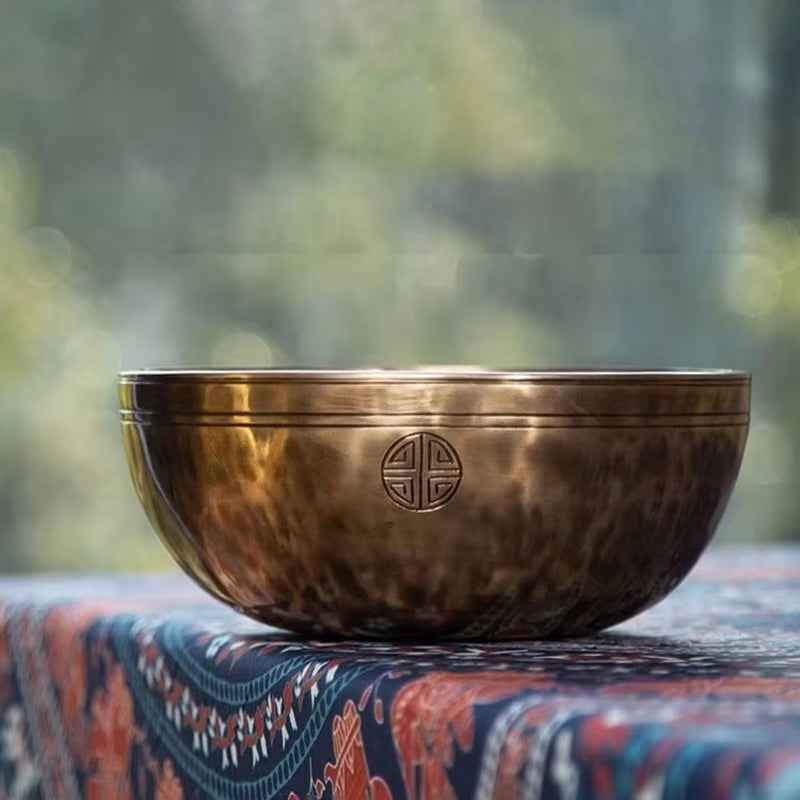


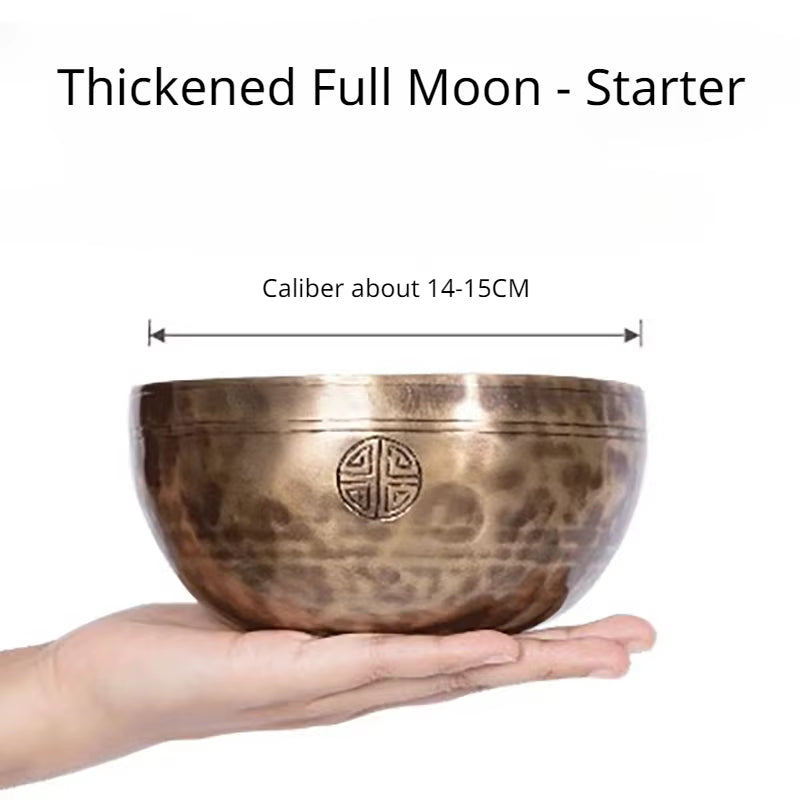

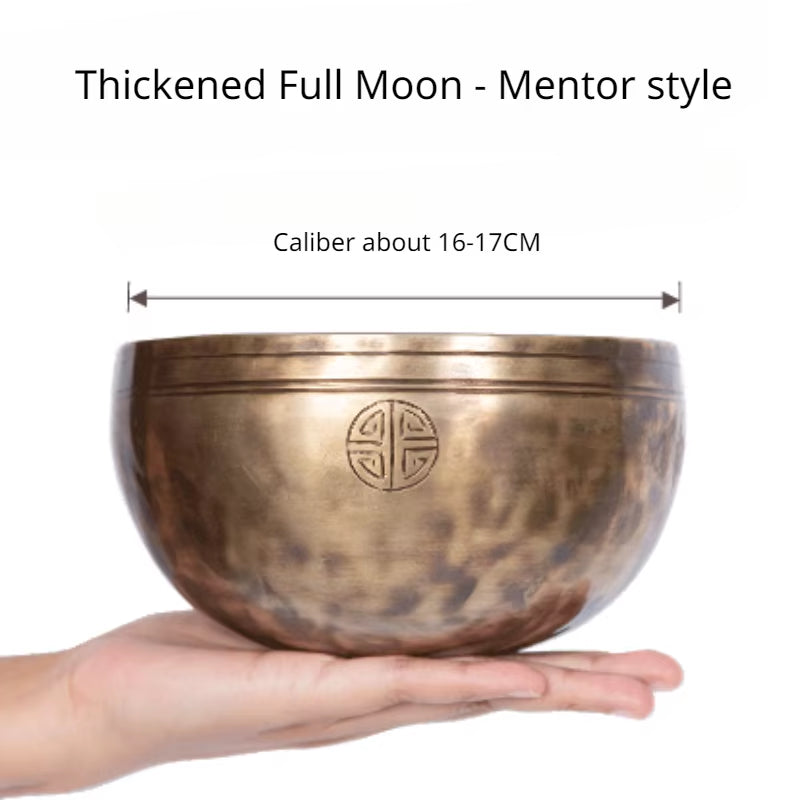
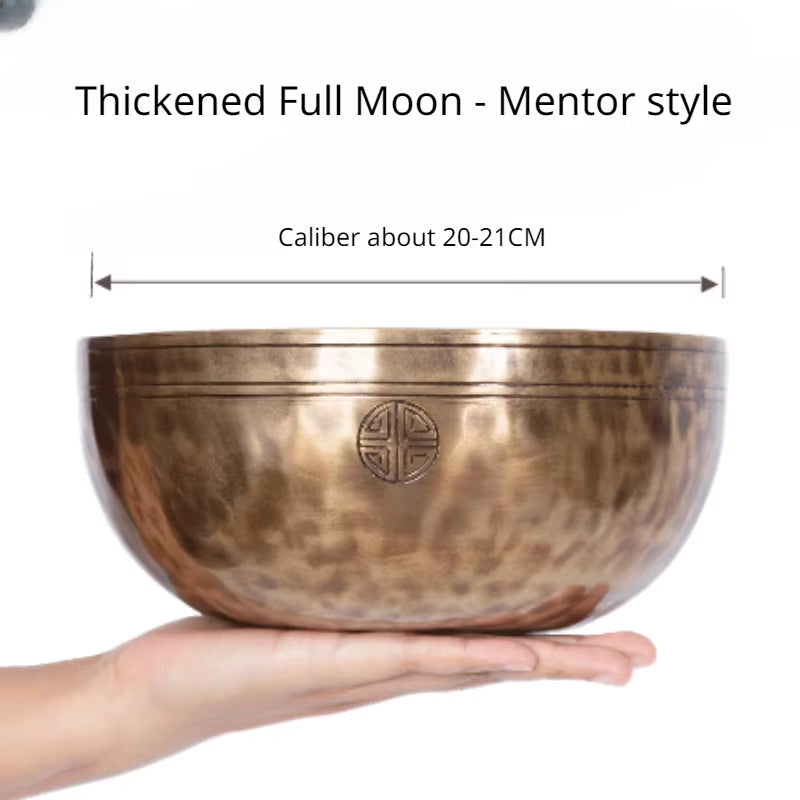



Beginner Friendly

Calms the Mind

Deepens Meditation
Handcrafted Quality


Getting Started
Yes. This bowl responds easily to both striking and rimming techniques—you'll create beautiful, sustained tones from your very first session. Unlike cheap mass-produced bowls that are difficult to play and produce weak tones, this bowl is designed to be beginner-friendly while maintaining professional sound quality.
What you get: the bowl, a mallet for playing, a cushion, and basic instructions. Everything you need to start.
People use singing bowls for different needs:
- Stress relief – Play at the beginning or end of your day to signal your nervous system it's time to shift gears
- Meditation – Use the sound as a focal point to anchor your attention when your mind wanders
- Yoga practice – Strike during transitions or to mark Savasana
- Sound healing – Move the bowl around the body to address tension or energetic blockages
- Daily ritual – A moment of intentional pause in an overstimulated world
None. There are only two basic techniques: striking (hitting the rim with the mallet) and rimming (circling the mallet around the edge). Both are intuitive and can be learned in minutes.
The bowl's design ensures that even imperfect technique produces harmonious sounds—there are no "wrong notes" with a singing bowl.
This bowl produces sustained resonance of 20-30+ seconds depending on striking technique and the bowl's size. This extended sustain is a hallmark of quality construction—cheap bowls typically fade within 5-10 seconds.
With rimming technique, you can sustain the sound indefinitely, creating continuous waves of vibration.
Sound Quality & Authenticity
Authentic singing bowls have distinctive characteristics:
- Sound: Complex, layered overtones with 20+ second sustain (cheap bowls sound "flat" or "tinny" with rapid decay)
- Weight: Substantial heft from proper metal alloy composition (not lightweight stamped sheet metal)
- Response: Vibrates strongly when played—you feel it in your hands
- Construction: Visible evidence of traditional craftsmanship including hand-finished details
We provide detailed specifications, sound samples (when available), and transparent sourcing because authenticity is the #1 concern we hear from informed buyers.
If a sound sample is available on this product page, you can hear this specific bowl before purchasing. Listen for three qualities:
- Fundamental note – The primary tone you hear immediately
- Sustain – How long the sound continues
- Overtones – The subtle harmonic layers that emerge as the sound evolves
Use quality headphones or speakers when listening—phone speakers cannot accurately reproduce the bass frequencies and subtle overtones that give singing bowls their therapeutic power.
Note: Sound samples are provided when available. Every authentic hand-crafted bowl has a unique voice.
Price reflects fundamental quality distinctions:
Budget bowls ($20-50):
- Machine-stamped from thin sheet metal
- Weak tones with poor sustain (5-10 seconds)
- Lack complex overtones
- Essentially decorative objects
Quality bowls (this one):
- Proper metal alloy composition
- Appropriate thickness for resonance
- Rich, penetrating tones
- 20-30+ second sustain
For personal meditation, a budget bowl might suffice. For professional use or serious practice, the difference is unmistakable the moment you strike it.
Consider: Would you rather buy twice (cheap now, quality later) or invest in an instrument that serves you for decades?
Hand-hammered: Each hammer strike creates subtle irregularities that produce complex, organic overtones and longer sustain. The craftsmanship creates sonic depth.
Machine-made: Cast or stamped using molds, producing uniform but simpler sound with fewer overtones and shorter sustain.
Think of it like comparing a handmade ceramic mug to a factory-pressed one—both hold liquid, but the craftsmanship and character are entirely different.
For sound healing, hand-hammered bowls are preferred because the complex overtones create the "layers" of sound that facilitate deep meditative states.
Choosing The Right Bowl
Size determines three factors: pitch, volume, and portability.
Small (4-6 inches):
- Higher, brighter tones
- Perfect for personal meditation and small spaces
- Easy to travel with
Medium (6-9 inches):
- Warm, balanced tones
- Ideal for professional use, yoga classes, small groups (3-5 people)
- Best versatility
Large (10+ inches):
- Deep, bass frequencies
- Required for large groups (8-12+ people) or outdoor spaces
- Studio instruments
Starting out? Mid-sized bowls (6-7 inches) offer the best versatility. Most practitioners eventually own multiple sizes for different applications.
For chakra work: Each note correlates to a specific energy center:
- C – Root
- D – Sacral
- E – Solar Plexus
- F – Heart
- G – Throat
- A – Third Eye
- B – Crown
For harmony: If you own other instruments, consider notes that harmonize (musical fifths like C-G or fourths like C-F).
First bowl for general meditation? The note matters less than the sound quality and your personal response to the tone. Trust your intuition—the "right" note is the one that resonates with you emotionally when you hear it.
Start with your primary intention:
- Personal daily meditation → Smaller, portable bowls with clear tones
- Professional client work → Mid-to-large bowls with powerful projection
- Group sound baths → Large bowls with deep bass frequencies
Then:
- Invest in the highest quality you can afford—one excellent bowl serves you better than three mediocre ones
- Listen to sound samples and trust your emotional response
- If unsure, contact us for personalized guidance
Remember: There's no objectively "best" bowl, only the best bowl for you and your specific needs.
Usage & Technique
STRIKING TECHNIQUE:
- Hold the bowl in your flat palm or place it on its cushion
- Hold the mallet like a pen
- Strike the bowl's outer rim at a 45-degree angle with moderate force
- Let the mallet bounce off immediately (don't let it rest—this dampens the sound)
- Listen as the sound develops and sustains
RIMMING TECHNIQUE:
- Hold the mallet like you're stirring a pot
- Press the mallet against the outer rim
- Move in slow, steady circles with constant contact and even pressure
- Be patient—it may take 3-5 circles before the singing sound emerges
Common beginner mistakes: Pressing too hard (creates friction noise), moving too fast (creates chatter), or applying uneven pressure (causes tone to jump).
Tip: Practice striking first to understand the bowl's natural resonance, then progress to rimming.
Depends on the bowl's size and weight:
Smaller bowls (4-6 inches): Can be gently placed on the body—commonly on back, stomach, or other fleshy areas—and struck or rimmed to send vibrations directly into tissue. This technique ("body singing") is popular for releasing muscular tension.
Larger, heavier bowls: Typically played near the body rather than on it due to weight.
Safety guidelines:
- Use extra padding (towel or blanket) between bowl and skin
- Never place on bony areas, joints, or the head
- Always communicate about pressure and comfort levels
- For self-treatment: back, stomach, chest, and thighs work well
Singing bowls produce focused, directional sound that dissipates quickly with distance and closed doors. A bowl played at normal intensity in a bedroom is clearly audible throughout the room but typically doesn't penetrate walls enough to disturb neighbors.
For shared spaces:
- Play more softly (gentle striking produces beautiful tones at lower volume)
- Choose smaller bowls (less projection than large bowls)
- Use during daytime hours
- Many family members grow to appreciate the calming effect once they experience it
Comparison & Compatibility
Metal and crystal bowls are complementary tools with distinct characteristics:
Tibetan/Metal Bowls:
- Warm, complex overtones with grounded, earthy quality
- More portable and durable
- Easier for beginners to play
- Generally more affordable
Crystal/Quartz Bowls:
- Pure, penetrating tones with spacious, ethereal quality
- Louder, project further (excellent for large groups)
- Fragile, require more technique
- Significantly more expensive
Neither is objectively "better"—they serve different purposes. Many professional practitioners own both: metal bowls for grounding and intimate work, crystal bowls for energetic clearing and large spaces.
Starting out? Metal Tibetan bowls are more forgiving and versatile.
Singing bowls integrate beautifully with virtually all sound healing modalities:
- With tuning forks: Use the bowl to create an ambient soundscape while applying forks to specific points—the sustained tone holds space while forks provide precision work.
- With gongs: Bowls work as "before and after" instruments—gentle bowl tones prepare clients before intense gong work or ease them back afterward.
- With other singing bowls: Multiple bowls create layered soundscapes. Choose complementary notes (C-G fifths) or chakra sequences (Root to Crown).
- With recorded music: Bowls add live, tactile vibration that recordings cannot provide—you feel it in your body, not just your ears.
Key principle: Singing bowls are versatile anchors that enhance rather than compete with other tools.
Absolutely. The bowl's live, tactile vibration adds a dimension that recorded sound cannot replicate.
- With guided meditations: Play during transitional moments (beginning, ending, between sections) or silent interludes—provides an auditory anchor without competing with the voice.
- With recorded music: Choose bowls whose note complements the music's key, or use at lower volume as an atmospheric layer.
Tip: Experiment with timing and volume—the bowl should enhance the experience, not overpower it.
Care & Maintenance
Regular cleaning:
- Wipe with a soft, dry cloth after each use
- Removes oils from hands and dust
Deep cleaning:
- Use slightly damp cloth with mild soap
- Dry thoroughly
- Avoid harsh chemicals or abrasive materials
Storage:
- Store on its cushion in a dry location
- Avoid extreme temperature changes
- Never store heavy objects on top (could distort shape and alter tone)
- Wrap in soft cloth or padded case for transport
With proper care, a quality singing bowl maintains its sound integrity for decades—many antique Tibetan bowls still sound beautiful after centuries.
Quality metal bowls are remarkably durable compared to crystal bowls. They can withstand normal use, travel, and occasional bumps without damage.
However:
- Dropping on hard surfaces could create dents, cracks, or distortions affecting sound
- Repeated impacts to the same spot can weaken the metal
- Most common damage is cosmetic scratching (affects appearance, rarely impacts sound)
Treat with reasonable care (don't drop it, don't store where it can be knocked over) and it will last a lifetime.
If damage occurs: Small dings often don't significantly alter sound. Larger cracks or warping will change acoustic properties.
Many practitioners believe singing bowls absorb vibrational information from their environment and use. Regular "cleansing" is seen as energetic maintenance.
Common cleansing methods:
- Sound – Playing other bowls or bells over it
- Smoke – Passing sage or palo santo around it
- Intention – Holding the bowl and consciously releasing stored energies
- Moonlight – Placing under full moon overnight
- Playing – Simply playing it with deliberate intention to clear and reset
Note: These practices are based on metaphysical beliefs, not physical science. Whether you choose to do this depends on your personal worldview.
Many practitioners find regular cleansing important. Others simply clean it physically. There's no "wrong" answer—follow what feels right for your practice.
Safety & Contraindications
Singing bowls are generally safe, but there are important contraindications.
Do not use on or near:
- People with pacemakers or implanted medical devices (sound could interfere with function)
- Pregnant individuals (especially first trimester—get healthcare provider clearance)
- People with epilepsy or seizure disorders (certain frequencies could trigger episodes)
- People with severe tinnitus (loud tones could exacerbate condition)
- Anyone with acute inflammation, recent injuries, or metal implants where bowl will be played
Always ask about these conditions before using bowls on others.
For self-use: If you have any of these conditions, consult your healthcare provider first.
When in doubt: Play near the body rather than on it, use gentler volume, shorter sessions.
Yes, with appropriate supervision and guidance.
Young children (under 8): Should use with adult present—they may strike too hard, drop the bowl, or play at inappropriate times.
Older children and teens: Often love singing bowls for stress management, focus, and bedtime routines.
When introducing to children:
- Emphasize it's a special tool requiring gentle, respectful handling (not a toy)
- Show proper technique
- Establish clear guidelines about when and where they can play it
Many families find singing bowls become a cherished tool for helping anxious or overstimulated children calm down—the act of making the sound gives them an embodied focus point.
This depends on severity and how you use the bowl.
For hyperacusis or certain types of tinnitus: The sustained, penetrating tones can be uncomfortable or even painful.
Start gently:
- Strike softly
- Play for brief periods (30 seconds to 1 minute)
- Keep bowl at arm's length rather than close to head
- Stop immediately if you experience discomfort
Some people find:
- They can tolerate bowls played softly at a distance but not up close
- Specific frequencies work better (lower-pitched vs. higher, or vice versa)
If you have diagnosed audio issues: Discuss singing bowl use with your audiologist before purchasing.
Alternative: If too intense for direct use, have someone else play it while you're in another room, or use in extremely gentle ways.
Professional Use
For individual client sessions: This bowl is excellent. The tone quality meets the standards clients expect from professional practitioners.
For group sound baths: Consider your group size and space:
- Intimate groups (2-4 people) in smaller studios → This size works well
- Larger groups (8-12+ people) or big spaces → Pair with larger instruments for more bass and projection
Professional tip: One quality bowl used skillfully creates more therapeutic impact than many mediocre instruments played poorly. Most practitioners start with bowls like this and expand their collection as their practice grows.
This bowl is appropriate for both personal practice and professional client work.
For professional use, ensure you understand:
- Proper sound healing protocols
- Client consent
- Contraindications (pacemakers, pregnancy, epilepsy, tinnitus)
- Appropriate volume levels
- Integration with your scope of practice
If offering sound healing as standalone service: Research certification options in your area. While not legally required in most places, certification provides:
- Credibility
- Insurance eligibility
- Deeper technique training
Remember: The bowl is a tool. Your skill, intention, and client care protocols determine its therapeutic effectiveness.